
Nail Fungus or Just Damaged Nails?
How to tell the difference, plus what over-the-counter treatments can actually do if it turns out to be fungus.
Yellowed, thickened, or crumbling nails don't always mean fungus. Gel manicures, press-ons, and even nail polish worn too long can leave nails looking almost identical to a fungal infection — which means a lot of people are treating the wrong problem.
Is It Fungus, or Did Your Manicure Do This?
|
🟢 Likely Cosmetic
|
🔴 Likely Fungal
|
Rule of thumb: smooth and confined usually means cosmetic damage. Spreading and textured usually means fungus — and that's when the treatments below apply.
What OTC Treatments Can (and Can't) Do
Nail fungus lives beneath a hard, dense nail plate, which makes it genuinely difficult for any topical product to reach. Published cure rates for OTC-style topical formulations tend to fall well below those seen with oral prescription therapy (American Academy of Family Physicians). Prescription oral terbinafine reaches the nail bed through the bloodstream, with complete cure rates commonly landing in the 35–40% range, and mycological cure rates closer to 70% in some trials (Medscape).
That gap doesn't mean OTC options are worthless. For mild surface discoloration or a single affected nail caught early, a consistent topical routine can make a real difference — but most need three to twelve months of daily use before any visible improvement, since nails only grow roughly one to two millimeters per month for toenails (PubMed).
Top Over-the-Counter Treatments Worth Trying

|
Best for mild, early discoloration
Fungi-Nail Anti-Fungal Solution Built around tolnaftate 1%, a well-established topical antifungal. Comes with a brush applicator for full nail coverage or a targeted pen for smaller areas — one of the most consistently reviewed products in this category.
|
|
Best for visible appearance
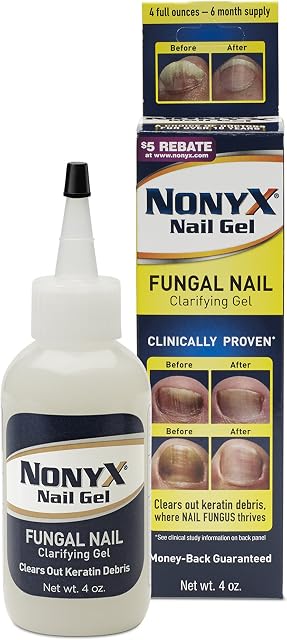
NONYX Fungal Nail Clarifying Gel Not a traditional antifungal — it softens the keratin buildup that makes nails look thick, yellow, and lifted, so damage grows out faster. Frequently used alongside a true antifungal rather than alone.
|
Can You Still Wear Polish or Gel While Treating It?
Regular polish traps moisture and can worsen a fungal infection by creating an environment fungus thrives in. If coverage matters during treatment, an antifungal-specific nail polish is safer than a standard cosmetic formula — and it's worth holding off on gel manicures or press-ons until the nail bed has fully reattached, since sealing over an active infection makes it harder to track improvement.
When to See a Doctor Instead
OTC treatments are worth trying for mild, early cases, but they're not a substitute for professional care once an infection has progressed.
See a doctor or podiatrist if:
- Two months of consistent OTC use produces no visible improvement
- More than half the nail is thickened or discolored
- Multiple nails are affected
- Pain, swelling, or lifting from the nail bed develops
Anyone managing diabetes, poor circulation, or a weakened immune system should see a doctor before starting any treatment, since fungal infections carry added risk in those situations.
Frequently Asked Questions
Is the "Orivelle Fungus Pen" (or "Orvelle") legitimate?
This heavily-advertised product shows up under several spellings (Orvelle, Orville, Orivelle) largely because it's driven by paid ads rather than organic word of mouth. It's worth knowing before ordering: it's a cosmetic product, not FDA-approved, and the brand's own materials state it isn't intended to diagnose, treat, cure, or prevent any medical condition. Multiple independent write-ups frame it as an open question — "is it a scam or legitimate?" — with complaint patterns clustering around shipping delays, refund clarity, and billing transparency. If you're looking for an actual antifungal option with an established active ingredient, the Fungi-Nail and NONYX picks above are a more transparent starting point.
How do I know if it's fungus or just damage from gel/press-ons?
Cosmetic damage tends to be smooth, confined to the area under the product, and improves once the nail grows out. Fungus tends to spread over time, thickens the nail, and often starts as a streak near the tip rather than across the whole surface.
Are Lamisil and Jublia available over the counter?
Lamisil is available in a lower-strength OTC cream for athlete's foot and skin fungus, but the oral tablet form used for nail fungus requires a prescription. Jublia is prescription-only and not sold through general retailers like Amazon.
How long does OTC nail fungus treatment take to work?
Most OTC antifungal products need three to twelve months of consistent daily use before any visible change appears, since a nail can only grow out as fast as new tissue replaces the old — roughly one to two millimeters per month for toenails (PubMed).
Final Thoughts
Not every discolored or thickened nail is fungus — a lot of it comes down to how nails are treated day to day. But when it is fungus, over-the-counter treatments have a real but limited role: they work best on mild, surface-level cases caught early, and they demand months of patience rather than a quick fix. Anything beyond that scope calls for prescription treatment and professional guidance.